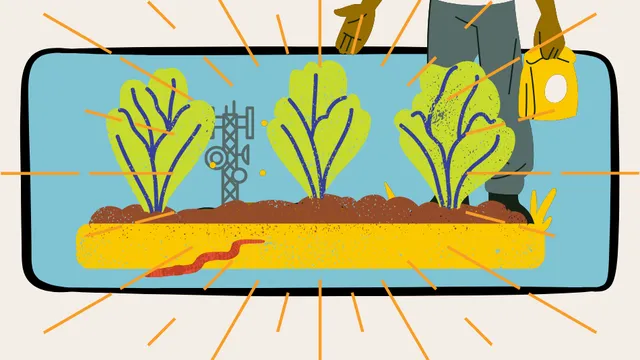
Gardens matter. Humanity began in a garden. Cultivation produces fruit, but fruit is not the only outcome. Stewardship of soil and water is a gift passed to the next generation, and the work itself forms the worker. Gardens are also places of relationship, where people work beside one another, share knowledge, solve problems, and learn through presence. Technology can ease the friction of work, and sometimes that is exactly what it should do. But effort is also one of the ways people develop strength, skill, memory, judgment, and connection. The garden matters, but so does what tending the garden does to the gardener.
Gardens Matter.
What Technology Should Leave Behind in Us
The garden matters, but so does what tending the garden does to the gardener.
Digital tools are often evaluated by what they help us accomplish: how much time they save, how much work they automate, how quickly they produce an answer. Those measures matter, but they are incomplete. A tool can increase productivity while quietly reducing opportunities to practice memory, judgment, navigation, conversation, or creative effort. As artificial intelligence becomes more capable, the question is no longer simply whether a task can be delegated. It is whether delegating it leaves the user more capable, less capable, or simply capable in a different way.
There is a deeper reason to be cautious about shortcuts.
Large language models are trained on vast collections of human-produced text, code, images, and other data—the recorded products of generations of observing, questioning, arguing, failing, revising, teaching, and discovering. A machine can draw patterns from that record almost instantly. A person cannot. From childhood through old age, human understanding develops through experience, practice, relationship, correction, and time. We may be able to shorten the path to an answer, but we should be careful not to confuse that with shortening the path to understanding. Some parts of that path may be difficult precisely because walking them is part of how we grow.
This distinction matters because many of the capacities we value are maintained through use. Memory strengthens through retrieval. Judgment develops through repeated choices and correction. Skill grows through practice. Relationships deepen through attention, conversation, and shared work. Research on learning supports the broader principle that easier performance is not always better learning: Robert and Elizabeth Bjork’s work on “desirable difficulties” shows that some forms of effort that slow performance in the moment can strengthen long-term retention and transfer. Shannon Vallor extends a similar concern into the philosophy of technology, warning that when technologies repeatedly remove opportunities to exercise human capacities, they can contribute to forms of deskilling. The challenge, then, is not to preserve difficulty for its own sake. It is to distinguish between friction that merely obstructs us and friction that helps form us.
This concern has a longer philosophical history. Ivan Illich argued that good tools should expand people’s capacity to act rather than increase dependence, while Albert Borgmann emphasized practices that engage skill, attention, community, and meaning. Across these perspectives, a useful principle emerges: tools should be judged not only by what they produce, but by what kind of user they help form.
From the beginning, human work has never been only about production.
It has also involved: creation, service, and judgment. These are not merely outputs; they are human capacities developed through repeated practice. As digital tools increasingly assist with writing, planning, communication, diagnosis, recommendation, and decision-making, they are entering precisely those areas where formation has traditionally occurred. The question is no longer simply whether technology can help us perform the work. It is whether our way of using it preserves opportunities to create, serve, and judge well.
That question becomes especially important with artificial intelligence because AI does not simply automate physical effort; it can now participate in language, analysis, planning, and decision support. Research on cognitive offloading shows that people routinely use external tools to reduce the demands placed on memory and attention, often with real benefits. But those benefits can come with tradeoffs when the external aid replaces rather than supports internal skill. The goal is not maximum effort or maximum automation. It is the right relationship between the two.
A useful distinction is between obstructing friction and helpful friction.
Obstructing friction consumes time without strengthening a meaningful human capacity: repetitive formatting, duplicate-file searches, or routine administrative steps. Helpful friction exercises capacities we want to keep—remembering, interpreting, choosing words, solving problems, noticing patterns, and working through disagreement. Research on desirable difficulties and productive failure suggests that some effort can deepen learning even when it slows performance. The practical question is not simply whether technology removes friction, but what kind of friction it removes—and what human capacity was being exercised there.
This leads to a more useful test for adopting digital tools.
- Before handing over a task, ask:
- What capacity am I about to delegate?
- During the work, ask:
- Am I removing obstructing friction or helpful friction?
- After the task is complete, ask:
- Could I still perform the important part myself?
These questions do not assume that delegation is harmful. In many cases, technology expands access, reduces unnecessary burden, and allows people to focus on higher-value work. But they shift evaluation away from efficiency alone and toward agency. A successful tool should not merely help us finish the task; whenever possible, it should leave us more capable of understanding, choosing, creating, serving, and acting well.
One way to put this into practice is to preserve a small portion of the work for ourselves.
- Before using GPS, picture the route.
- Before asking AI to draft, write a few sentences.
- Before using a calculator, estimate the answer.
- Before accepting a summary, try to state the main idea from memory.
These small acts keep the tool in the role of assistant rather than substitute. Research on retrieval practice, generation, and spatial learning suggests that active participation helps preserve memory and understanding, while heavy reliance on external aids can reduce what we encode for ourselves. The aim is not to reject convenience. It is to use convenience without surrendering the capacities we still want to carry.
A second practice is to use a ‘hand-back test’. After a digital tool assists with a task, occasionally step away from it and ask whether you can still explain the reasoning, repeat the process, or make the decision on your own.
- If AI helped summarize a report, can you state the central argument without reopening the summary?
- If a navigation app guided you somewhere new, can you identify the landmarks that would help you return?
- If software generated a recommendation, can you explain why you agree with it?
This kind of check turns digital use into an opportunity for reflection rather than passive acceptance. It also makes dependency visible before it becomes habitual.
Not every pause is valuable. But a life without pauses leaves little room for reflection, and without reflection experience does not automatically become understanding. Aristotle’s account of practical wisdom depends on more than possessing information; it is formed through experience, deliberation, and judgment about what a situation requires. Shannon Vallor carries a related insight into the technological age, arguing that human capacities are cultivated through practice and can be weakened when technologies repeatedly remove the occasions in which those capacities are exercised. The spaces between action and completion—waiting, reconsidering, remembering, choosing—may therefore matter more than they first appear. They are often where we take ownership of what we have learned and of the choices we are making.
Digital enablement, then, should not be measured only by speed, adoption, or output. A useful technology may save time, expand access, reduce error, or make difficult work possible. But a fuller measure asks what happens to the person using it. Does the tool increase confidence, judgment, independence, and the ability to act? Or does it create a dependence that becomes visible only when the system is unavailable? This shifts the goal from maximum automation to ‘supported agency’: using technology in ways that extend human capability without quietly hollowing out the capacities on which that capability depends.
The goal is not to preserve difficulty for its own sake, nor to resist tools that make life easier. It is to notice what kind of person our tools are helping us become. Good digital enablement should reduce unnecessary burden while preserving the practices that strengthen judgment, memory, creativity, relationship, and agency. That requires attention before we delegate, awareness while friction is being removed, and reflection after the work is done. The garden matters. The fruit matters. But so does the gardener.
References
Aristotle. (1999). Nicomachean ethics (T. Irwin, Trans.; 2nd ed.). Hackett Publishing Company.
Bjork, R. A., & Bjork, E. L. (2020). Desirable difficulties in theory and practice. Journal of Applied Research in Memory and Cognition, 9(4), 475–479. https://doi.org/10.1016/j.jarmac.2020.09.003
Borgmann, A. (1984). Technology and the character of contemporary life: A philosophical inquiry. University of Chicago Press.
Dahmani, L., & Bohbot, V. D. (2020). Habitual use of GPS negatively impacts spatial memory during self-guided navigation. Scientific Reports, 10, Article 6310. https://doi.org/10.1038/s41598-020-62877-0
Illich, I. (1973). Tools for conviviality. Harper & Row.
Kapur, M. (2008). Productive failure. Cognition and Instruction, 26(3), 379–424. https://doi.org/10.1080/07370000802212669
Risko, E. F., & Gilbert, S. J. (2016). Cognitive offloading. Trends in Cognitive Sciences, 20(9), 676–688. https://doi.org/10.1016/j.tics.2016.07.002
Roediger, H. L., III, & Karpicke, J. D. (2006). Test-enhanced learning: Taking memory tests improves long-term retention. Psychological Science, 17(3), 249–255. https://doi.org/10.1111/j.1467-9280.2006.01693.x
Sparrow, B., Liu, J., & Wegner, D. M. (2011). Google effects on memory: Cognitive consequences of having information at our fingertips. Science, 333(6043), 776–778. https://doi.org/10.1126/science.1207745
Vallor, S. (2015). Moral deskilling and upskilling in a new machine age: Reflections on the ambiguous future of character. Philosophy & Technology, 28(1), 107–124. https://doi.org/10.1007/s13347-014-0156-9
Vallor, S. (2016). Technology and the virtues: A philosophical guide to a future worth wanting. Oxford University Press.
Join our mailing list!
Enter your email address to receive updates.
Written By